
| A Semantic Content Network (SCN) is a governed website architecture built on boundary definition, role assignment, authority control, and retrieval-directed linking. A topical map can organize themes, but it does not govern structure, authority, or decision gravity – which is why many architectures look organized on paper and still collapse in practice. |
A website can cover hundreds of related topics and still fail structurally. The failure is not a lack of content – it is a lack of constitutional governance. If the site does not define what it owns, how its pages relate to each other, and where evaluative judgment is allowed to live, the structure will drift, fragment, and eventually collapse under its own weight.
This article explains the SCN Constitution as an architectural model – not as a content checklist or a bigger version of a topical map. It introduces the framework’s core vocabulary, its three-axis logic, its authority models, and the compliance standard that makes structural quality measurable.
The SCN Constitution was developed by Sergey Lucktinov as a governance standard for building Semantic Content Networks that survive real-world implementation. The framework emerged from a pattern observed across multiple SCN projects: architectures built on topical maps and semantic SEO principles consistently collapsed under implementation pressure – not because the underlying methodology was wrong, but because no governance layer existed to control boundary drift, authority fragmentation, role assignment, and corridor discipline at scale.
Existing models provided the conceptual foundation – particularly the semantic SEO methodology pioneered by Koray Tuğberk Gübür, which established topical authority, entity-based optimization, and semantic content networking as core practices. What was missing was a constitutional standard that formalized how those principles translate into stable, auditable, implementation-grade architecture. The SCN Constitution fills that gap.
The framework and its relationship to Semantic Retrieval Optimization (SRO) are detailed in Semantic SEO, SRO & AI: Get Found, Trusted, and Chosen in the AI Era (Lucktinov, 2025).
SCN vs Topical Maps: Why Most Website Structures Fail
Most website structures are built on topical maps. That approach works for brainstorming coverage ideas, but it is not architecture. Topical maps organize themes. SCNs govern scope, roles, authority, links, and site-tree logic. When the distinction is blurred, structures fail – not because they lack content, but because they lack constitutional law.
Collapse conditions are real architectural problems, not abstract criticisms. A site can have deep coverage and still lose coherence if no governing layer controls how pages relate, where authority lives, and what the site actually owns.
Why topical maps flatten structure into topic grouping
A topical map answers one question: what topics exist? It does not answer what constitutional role each page should hold, where boundaries lie, or how hierarchy flows. Grouping subjects by theme can be a useful planning aid, but it is not the architecture itself.
Think of it this way: a list of rooms is not a building plan. The list tells you what spaces exist. The plan tells you how they connect, which walls bear weight, and where the doors go. When grouped topics are mistaken for role assignments, role drift begins immediately.
Why topical maps fail to govern authority, links, and roles
Topical maps rarely define where evaluative language – words like “best,” “recommended,” or “worth it” – is allowed to live. They do not treat internal links as retrieval instructions with directional meaning. And they do not establish whether a page is acting as a Macro (identity territory), a Seed (corridor), or a Node (resolution page). A structure can look rich while remaining constitutionally underdefined.
| Governance Layer | What Topical Maps Usually Leave Undefined |
| Authority placement | Which pages are allowed to carry final evaluative judgment |
| Link directionality | Whether a link signals hierarchy, support, or decision routing |
| Role assignment | Whether a page is a Macro, Seed, or Node |
| Boundary logic | What the site owns vs. what it merely touches |
SCN vs topical maps at a glance
| Dimension | Topical Map | SCN |
| Boundary logic | Implicit or absent | Declared via Semantic Boundary Declaration (SBD) |
| Role assignment | Not defined | Macro → Seed → Node hierarchy |
| Authority governance | Not addressed | Distributed or Keystone authority model |
| Internal link function | Navigational connections | Retrieval instructions encoding hierarchy and authority flow |
| Seed design | Topic clusters or keyword groups | Territory-specific corridors with corridor discipline |
| Primary failure mode | Coverage gaps | Structural collapse from ungoverned roles, authority, and drift |
What a Semantic Content Network Actually Is
| Definition A Semantic Content Network (SCN) is an implementation-spec architecture that governs the relationships between scope, roles, authority, links, URLs, and publishing logic. It is built for structural stability under real implementation – not just conceptual coverage. |
An SCN is not a content idea board. It is a constitutional model that tells you what the site owns, what role each page holds, where judgment is allowed to collapse, and how every link, URL, and publishing decision reinforces that structure.
SCN as an implementation-spec architecture
A complete SCN includes every layer needed to survive implementation without collapsing into improvisation. “Complete” here means governance completeness – not topic breadth. Each layer exists because removing it creates a specific structural vulnerability.
| SCN Component | What It Governs | Why It Exists |
| Semantic Boundary Declaration (SBD) | Scope: what the site owns, does not own, and may bridge toward | Prevents adjacent-topic creep and macro explosion |
| Macro / Seed / Node roles | Page hierarchy and structural identity | Assigns constitutional function to every page |
| Authority mode | Where evaluative judgment is allowed to collapse | Prevents criteria drift and authority fragmentation |
| Bridges and HANs | Controlled transitions and cross-network stabilization | Enables movement without merging clusters |
| URL governance | Semantic site-tree structure | Reinforces cluster boundaries in the physical architecture |
| Internal link logic | Retrieval instructions encoding hierarchy and flow | Makes the constitutional structure machine-readable |
| Publishing order | Sequence of structural deployment | Ensures foundational layers exist before dependent ones |
| QA logic | Ongoing compliance verification | Detects drift before it becomes collapse |
What an SCN is not
| Common Misconceptions An SCN is not a pillar-page framework. It is not a bigger cluster model. It is not a keyword map. It is not just a topical authority tactic. And it is not merely an internal linking pattern. Each of these describes a single layer or tactic. An SCN governs the relationships between all of them under constitutional law. |
The Three Axes of an SCN
Every SCN depends on three separate axes. Most structural mistakes happen when these layers are collapsed into one. Each axis answers a fundamentally different question about the architecture.
| Axis | Core Question | What It Controls |
| Topology | How is the structure shaped? | Graph shape: Macro → Seed → Node, plus Bridges and HANs |
| Coverage | How is uncertainty resolved? | What the network must answer: definitions, mechanisms, risks, decisions, trust |
| Authority Governance | Where is judgment allowed to live? | Which pages carry final evaluative language and decision weight |
When these axes are treated as one – or when any axis is omitted – the structure becomes vulnerable. Topology without authority governance creates organized pages with no decision logic. Coverage without topology creates content volume with no structural hierarchy. Authority without boundary creates evaluative pages with no constitutional legitimacy.
Topology: how the structure is shaped
Topology is the shape of the network. It defines how pages move from Macro (identity territory) to Seed (corridor) to Node (resolution page), with Bridges and Horizontal Authority Nodes (HANs) where needed. Topology is not just page arrangement – it is a trust and movement model. Flat architectures dilute semantic prioritization and crawl focus because they treat every page as structurally equal.
Think of topology like a transit system. The Macro is the main station. Seeds are the lines running outward. Nodes are the stops along each line. Bridges are controlled transfer points between lines. If everything connects to everything, the map becomes meaningless.
Coverage: how uncertainty is resolved
Coverage resolves uncertainty rather than merely expanding topic lists. A well-covered network answers different types of questions: definitions, mechanisms, signals, risks, options, constraints, decisions, and trust. Coverage tells the network what must be answered, but it does not decide the role of each page – that is topology’s job.
The distinction matters because a site can have broad coverage and still be structurally broken. Fifty well-written articles do not form an architecture. They form a collection. Coverage becomes architectural only when it is assigned to governed roles inside a declared boundary.
Authority governance: where judgment is allowed to live
Authority governance controls where final evaluative judgment is allowed to collapse. This includes language like “best,” “recommended,” “should I choose,” “worth it,” and “vs” logic when it becomes final decision language. Authority is not tone or style – it is a design layer.
| Key Distinction: Coverage vs. Authority Coverage asks: “What does the reader need to know?” Authority asks: “Where is the reader told what to choose?” A page can cover pros and cons (coverage) without ever issuing a final recommendation (authority). When this distinction is ignored, evaluative language sprawls across the site and fragments the decision architecture. |
The Core Building Blocks of an SCN
SCN uses a locked constitutional vocabulary. These are not flexible labels – they are role-bound components inside a declared boundary. Vocabulary discipline is part of architectural discipline: if the terms can mean anything, the structure cannot be governed.
Semantic Boundary Declaration (SBD)
The SBD is the written line between what the site owns, what it does not own, and what sits adjacent to it. It is the first constitutional law because every other decision – role assignment, authority placement, link direction – depends on knowing the boundary. Without SBD, role assignment produces drift, and adjacent topics creep inward until the site’s identity becomes incoherent.
| Boundary Zone | Definition | Example (Specialty Coffee Site) |
| Owned | Topics the site has full constitutional authority to cover | Brewing methods, bean origins, grinder selection, tasting technique |
| Not owned | Topics the site must not claim or build architecture for | Tea varieties, energy drink formulation, restaurant management |
| Adjacent | Topics the site may bridge toward but never absorb | Water chemistry, kitchen design, general nutrition |
Macro, Seed, and Node
A Macro is the top-level intent unit the site would lose identity without. Remove a Macro from a specialty coffee site – say, “Brewing Methods” – and the site no longer makes architectural sense. A Seed is a sub-intent corridor within a Macro, capable of generating multiple Nodes. “Pour-Over Technique” under Brewing Methods is a Seed – it opens a pathway, not just a single answer. A Node is a constrained resolution page under a Seed: “Best Water Temperature for Pour-Over” resolves one specific question inside that corridor.
These roles are relative to the declared boundary, not fixed by topic size. On a general food site, coffee might be a single Node. On a coffee-only site, it becomes the entire architecture. Role is always boundary-relative.
| Role | Structural Function | Diagnostic Test |
| Macro | Top-level identity territory | Would the site lose its identity without this? |
| Seed | Sub-intent corridor generating multiple Nodes | Does this open a territory-specific pathway? |
| Node | Constrained resolution page | Does this resolve one question inside a Seed’s corridor? |
Node taxonomy
Not all Nodes are structurally equal. SCN defines four constitutional node types, each with a different role inside the architecture.
| Node Type | Role | Example |
| Core | Foundational – the Seed cannot function without it | “What Is Pour-Over Coffee?” |
| Interpretive | Applies the Seed’s territory to specific conditions or contexts | “Pour-Over for Hard Water Areas” |
| Secondary | Supports the corridor but is not structurally required | “History of Pour-Over Brewing” |
| Reference | Lookup or data resource within the corridor | “Pour-Over Brew Ratio Chart” |
Node taxonomy matters because it affects structural necessity. Removing a Core Node damages the corridor. Removing a Secondary Node does not. This distinction governs publishing priority, link weight, and architectural resilience.
Bridges
A Bridge is a controlled valve between clusters – not a merger. It allows movement between Seed corridors or Macros while preserving separation. Bridges support specific transition types: compare, switch, replace, alternatives, and constraint routing. The key principle is “connect without merging.” Too many uncontrolled cross-links weaken cluster boundaries and turn the architecture into an undifferentiated mesh.
Horizontal Authority Nodes (HANs)
HANs are sitewide or multi-Macro stabilizers – pages that serve the entire network rather than belonging to a single corridor. They strengthen structural stability without erasing role law. SCN defines three constitutional HAN categories:
| HAN Category | Function | Example |
| Entity Trust & Process | Establishes credibility and methodology | “About Our Testing Methodology” |
| Diagnostic & Risk | Identifies problems and decision-relevant risks | “Common Brewing Mistakes and How to Diagnose Them” |
| Decision & Economics | Supports economic reasoning and trade-off logic | “How Much Should You Spend on a Coffee Grinder?” |
Seed Corridor discipline
Seeds must describe territory-specific pathways, not generic query-frame buckets. Repeating “best,” “reviews,” “pricing,” or “comparisons” as identical Seeds across multiple Macros violates corridor discipline. Valid Seeds reflect how users move through a territory, not just how queries are phrased.
| Seed Example | Valid or Invalid? | Why |
| “Pour-Over Technique” under Brewing Methods | Valid | Territory-specific corridor generating distinct Nodes |
| “Best Products” under Brewing Methods | Invalid | Generic query frame – identical bucket could appear under any Macro |
| “Bean Selection for Espresso” under Espresso | Valid | Reflects how users navigate a specific territory |
| “Reviews” under Espresso | Invalid | Detached query frame, not a territory-bound corridor |
Authority Models in SCNs: Distributed vs Keystone
SCN supports two authority modes. The choice between them determines where final evaluative judgment is allowed to collapse across the entire network. This distinction is architectural, not stylistic – it changes how the site’s decision logic operates.
| Dimension | Distributed Authority | Keystone Authority |
| Evaluative hubs | Multiple, within local Macro jurisdiction | One primary evaluative frame (the Semantic Keystone) |
| Decision logic | Each Macro governs its own evaluative criteria | All Macros defer to one central decision authority |
| Risk profile | Criteria inconsistency across Macros | Single point of authority failure |
| Best suited for | Sites with genuinely independent evaluative territories | Sites where one decision domain dominates the architecture |
Distributed authority
Distributed authority allows multiple evaluative hubs, each operating inside its own local Macro jurisdiction. A site covering both “Home Audio” and “Car Audio” might legitimately need separate evaluative frameworks, because the criteria for judging speakers in a living room differ from those in a vehicle. The model works when evaluative territories are genuinely independent. It fails when local evaluators contradict each other or when criteria drift between Macros without anyone noticing.
Keystone authority
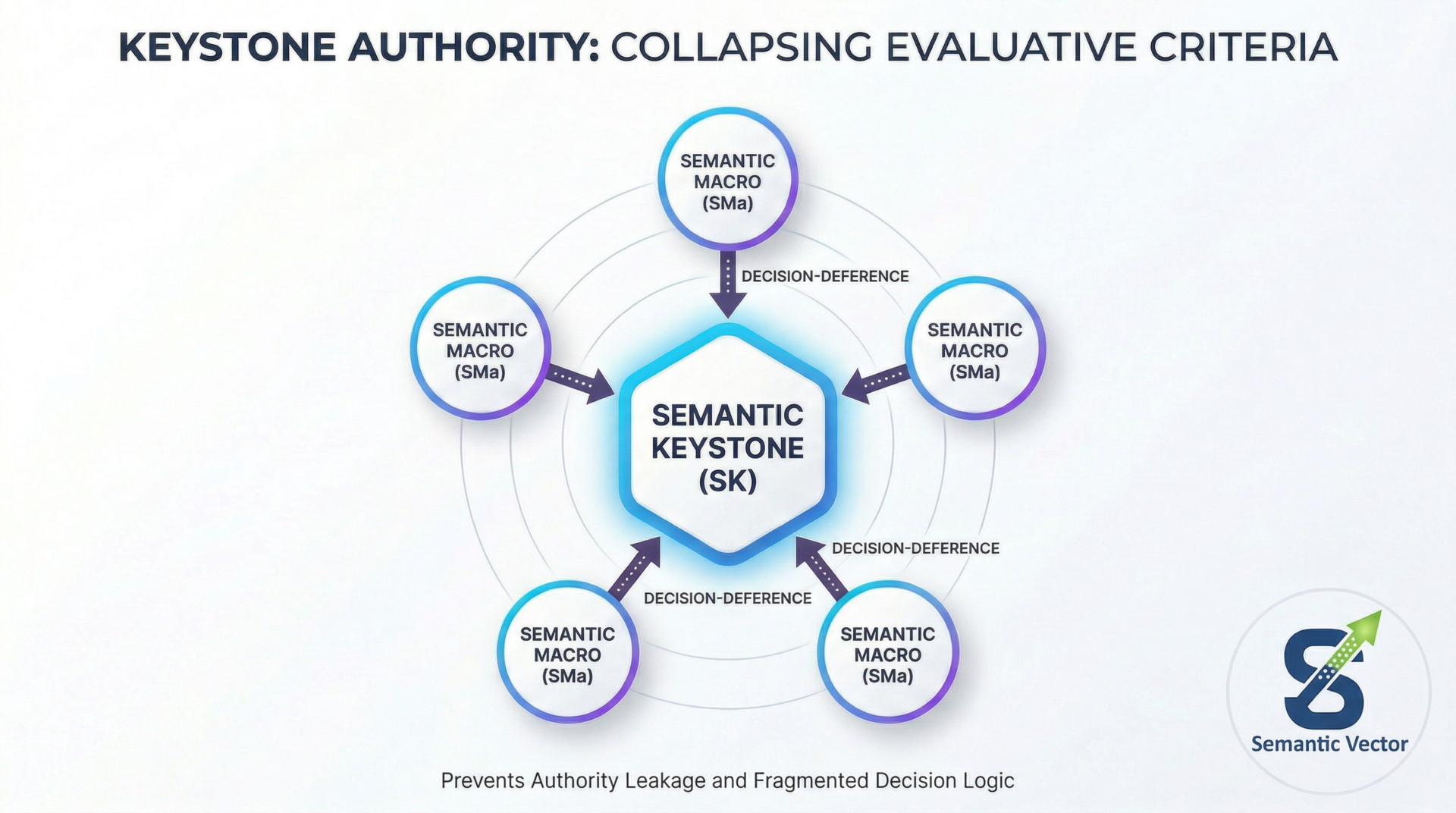
Keystone authority collapses final evaluative judgment into one primary evaluative frame – the Semantic Keystone (SK). In this model, other Macros support, constrain, or defer to the SK rather than independently redefining what “best” or “recommended” means. The Keystone model requires exactly one SK. If two Macros are both issuing final recommendations with conflicting criteria, the architecture has either chosen the wrong authority mode or has a fake Keystone problem.
Semantic Keystone (SK)
The SK is the one SCN-wide decision authority in Keystone mode. It governs evaluative language, monetization legitimacy, and internal link gravity weighting. SK is always a Macro-level designation – never a Seed or Node. Its uniqueness is non-negotiable: there is exactly one SK per SCN, or the architecture is not in Keystone mode.
| SK Governs | What This Means in Practice |
| Evaluative language | Only the SK Macro’s pages can issue final “best,” “recommended,” “top pick” judgments |
| Monetization legitimacy | Commercial recommendations flow from the SK, not from supporting Macros |
| Link gravity weighting | Internal links from the SK carry the highest decision-routing weight in the architecture |
Decision gravity and evaluative control
Decision gravity is the place where final evaluative judgment is allowed to collapse. In a well-governed SCN, decision gravity has a clear center. In a poorly governed one, it is scattered – multiple pages redefine criteria, contradict each other’s recommendations, and fragment the reader’s trust.
| Key Concept: Decision Gravity Competing evaluators create criteria drift and authority leakage. Evaluative language is not just wording – it changes architecture. A page that says “this is the best option” is making a structural claim about where decision authority lives. If that claim is not constitutionally sanctioned, the architecture is leaking. |
How SCNs Work in Practice
An SCN is visible through structure, not hidden in theory. Internal links, URLs, context fixation, and publishing order are the constitutional signals that make the architecture legible to both users and machines.
Internal links as retrieval instructions
In an SCN, internal links are not decorative connections – they are retrieval instructions. Every link encodes information about hierarchy, boundaries, and authority flow. A link from a Node to its parent Seed says “this page is subordinate to that corridor.” A link from a Seed to the SK says “this corridor defers to that decision authority.” Links are instructions about what is central, what is supporting, and what is decision-relevant.
| Link Direction | Structural Signal | Example |
| Node → Seed | Subordination: this page lives inside that corridor | Brew temp guide links back to Pour-Over Technique |
| Seed → Macro | Corridor belongs to this identity territory | Pour-Over Technique links to Brewing Methods |
| Node → SK (in Keystone mode) | Decision deference: this page supports the authority center | Informational page links to the evaluative hub |
| Bridge link | Controlled transition between clusters | “Alternatives to Pour-Over” links to Espresso corridor |
URLs as physical semantics
URLs are part of the site-tree, not just technical identifiers. In an SCN, URL structure reflects semantic cluster boundaries and parent-child intent relationships. URL governance reinforces cluster separation and role clarity.
A governed URL structure like /brewing-methods/pour-over/water-temperature tells the reader and the crawler exactly where this page sits in the architecture. A flat structure like /water-temperature-pour-over-guide removes that positional information, making the role ambiguous. URLs participate in meaning.
Macro-context identity fixation
Every page needs one dominant Macro context expressed in its title, H1, and opening frame. Mixed-context pages – ones that try to serve two Macros at once – drift in both classification and retrieval. “Pour-Over vs Espresso: Which Brewing Method Is Best?” fixes context on Brewing Methods. “Should You Buy an Espresso Machine or a Pour-Over Kit?” fixes context on purchasing decisions. The question is not which title is better – it is which Macro owns the page.
Publishing order and structural integrity
SCN publishing order is part of the architecture, not an afterthought. Foundational layers – Macros, Core Nodes, Seed corridors – should exist before dependent layers like Interpretive Nodes, Bridges, and monetized content. Structural integrity is easier to maintain when the base exists before the extensions. Random topical bursts create orphan pages that lack constitutional context.
Why SCN Governance Matters for AI Retrieval
Search engines are not the only systems reading your architecture. Large language models, AI-generated overviews, and retrieval-augmented generation systems now evaluate, extract, and cite content at a structural level that most website architectures were never designed to support. An SCN built under constitutional governance produces the exact structural properties these systems need to retrieve and cite with confidence. An ungoverned site – regardless of content volume – produces the exact properties that cause AI systems to skip it.
This is not a future concern. It is an active retrieval condition. AI systems are already selecting which passages to surface, which sources to cite, and which sites to treat as authoritative for a given query. The architectural signals that influence those decisions overlap directly with what the SCN Constitution governs.
How AI retrieval systems evaluate content differently from traditional search
Traditional search engines rank pages. AI retrieval systems retrieve passages. The distinction matters because a page can rank well as a whole while containing passages that are structurally ambiguous, evaluatively inconsistent, or contextually detached from the rest of the site. When a retrieval system is selecting a passage to cite in an AI-generated answer, it evaluates not just the passage itself but the structural context surrounding it – what the site claims to own, how the page relates to other pages, whether the authority signals are consistent, and whether the passage boundary is clean enough to extract without distortion.
An ungoverned site gives AI systems fragmented material to work with. Multiple pages may answer the same question with conflicting criteria. Evaluative language may appear on pages that have no constitutional authority to issue judgments. Internal links may encode no directional meaning, leaving the retrieval system unable to determine which page is the primary source and which is supporting. The result is low retrieval confidence – not because the content is bad, but because the architecture gives the system no basis for choosing one passage over another.
A constitutionally governed SCN resolves this by making every structural signal explicit and consistent.
How SCN governance maps to retrieval system requirements
Each constitutional layer in an SCN produces a specific structural property that AI retrieval systems use when evaluating whether to surface and cite a source.
| SCN Constitutional Layer | What It Produces | What the Retrieval System Gains |
| Semantic Boundary Declaration (SBD) | Clear topical scope with defined ownership zones | The system can assess whether the site is a legitimate authority for the query’s territory |
| Macro / Seed / Node hierarchy | Pages with explicit structural roles and resolution scope | The system can match the right passage to the right query level – category, corridor, or specific resolution |
| Authority governance (Distributed or Keystone) | Consistent evaluative language controlled by a declared model | The system encounters one coherent decision architecture, not competing evaluators with conflicting criteria |
| Internal links as retrieval instructions | Directional signals encoding hierarchy, subordination, and authority flow | The system can trace authority flow and determine which pages support, constrain, or defer to other pages |
| Corridor discipline | Seeds that describe territory- specific pathways, not generic query-frame buckets | The system encounters intent pathways that match how users actually navigate a topic, not duplicated frames across clusters |
| URL governance | Semantic site-tree structure reflecting cluster boundaries and parent-child relationships | The system can infer role and cluster membership from URL structure before processing content |
These are not aspirational benefits. They are structural consequences of following constitutional law. A site that declares its boundary, assigns roles, governs authority, enforces corridor discipline, and encodes hierarchy through links and URLs will produce these retrieval properties as a natural output of compliance.
Why ungoverned sites underperform in AI retrieval even with strong content
A site can have deep topical coverage, well-written articles, and strong backlink signals and still be passed over by AI retrieval systems. The reason is structural incoherence – the same failure pattern the SCN Constitution is designed to prevent.
Common retrieval failure signals from ungoverned architectures include contradictory evaluative claims across multiple pages, which make the system unable to determine which passage represents the site’s actual position. Pages with mixed intent – serving two Macros at once or combining definition with evaluation – produce passages that are contextually ambiguous when extracted. Internal links that encode no hierarchy give the system no way to distinguish primary sources from supporting pages. And generic Seeds repeated across every Macro produce structurally identical corridors that the system cannot differentiate by territory.
These are not content quality problems. They are governance problems. The content may be individually excellent while the architecture makes it structurally unreliable for passage-level retrieval.
| Key Distinction: Content Quality vs Architectural Quality Content quality determines whether a passage is worth retrieving. Architectural quality determines whether the retrieval system can find it, trust it, and cite it with confidence. Constitutional governance addresses the second problem. A site needs both, but architecture without content is empty and content without architecture is unreachable. |
The relationship between SCN governance and Semantic Retrieval Optimization (SRO)
The SCN Constitution operates within a broader retrieval optimization model. Semantic Retrieval Optimization (SRO) – a framework introduced in Semantic SEO, SRO & AI: Get Found, Trusted, and Chosen in the AI Era (Lucktinov, 2025) – defines five structural pillars that determine how modern retrieval systems evaluate and surface content: Macrosemantics (entity networks and topical authority), Microsemantics (passage-level meaning and contextual bridges), Technical Eligibility (indexing, rendering, and retrieval cost), Trust Calibration (authority signals that retrieval systems interpret), and Query Semantics (how intent, framing, and meaning shape results).
SCN Constitutional governance maps directly to this model. The SBD and Macro/Seed/Node topology produce macrosemantics – clear entity networks within declared boundaries. Constitutionally governed content with clean passage boundaries and self-contained definitions produces microsemantics – extractable meaning at the passage level. URL governance and crawl-efficient hierarchy produce technical eligibility – lower retrieval cost and cleaner signal paths. Authority governance – whether Distributed or Keystone – produces trust calibration through consistent, non-contradictory evaluative signals. And corridor discipline produces query semantics alignment – intent pathways that match how users and systems frame questions across the decision spectrum.
The SCN Constitution is the governance layer that ensures an architecture produces what SRO requires. SRO describes what retrieval systems evaluate. The SCN Constitution governs the structure so it passes that evaluation. The two frameworks are complementary: one defines the retrieval conditions, the other enforces the architectural compliance that satisfies them.
Good SCNs vs Bad SCNs
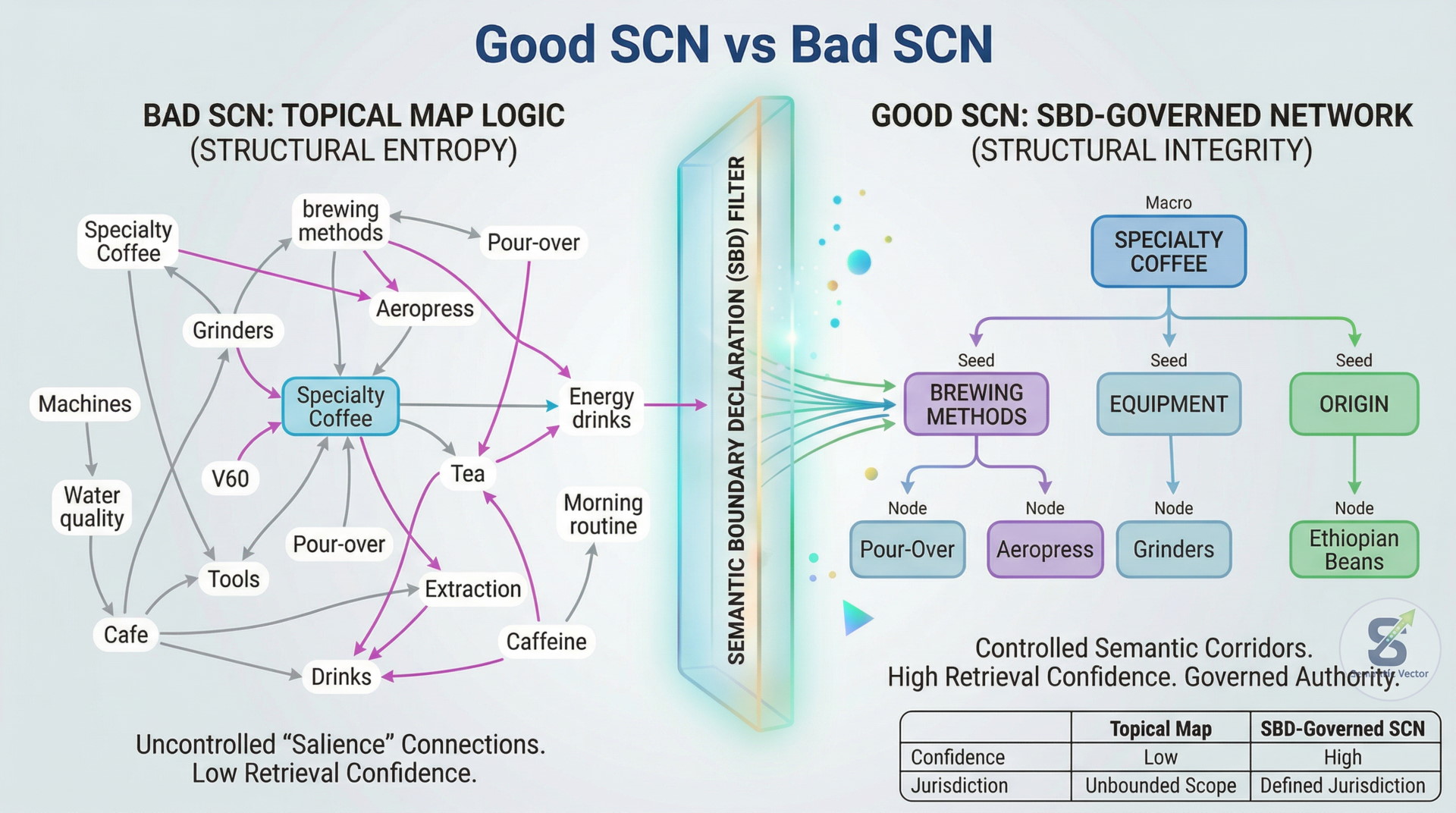
Abstract models become useful when you can see them working – and breaking. The difference between a strong SCN and a collapsing one is not content volume. It is governance.
Example of a strong SCN
Site: A specialty coffee education site.
The SBD declares ownership of brewing methods, bean origins, grinder selection, and tasting technique. It explicitly excludes tea, energy drinks, and restaurant operations. Macro territories are clear: Brewing Methods, Bean Origins, Equipment. Each Macro has territory-specific Seeds (Pour-Over Technique, Espresso Extraction, Single-Origin Sourcing) that open distinct corridors. Nodes resolve specific questions within those corridors. Authority is Keystone: the Equipment Macro holds the SK because all purchasing evaluations defer there. Internal links encode hierarchy – Nodes link to their parent Seeds, Seeds link to their Macros, and evaluative recommendations route through the SK. URLs follow the structure: /equipment/grinders/burr-vs-blade.
Example of a collapsing SCN
Site: A “beverage lifestyle” site with no declared boundary.
There is no SBD – the site covers coffee, tea, smoothies, cocktails, and energy drinks without defining what it owns. Seeds are generic query-frame buckets repeated across every Macro: “Best Products,” “Reviews,” “Buying Guides.” Multiple pages issue final “best” recommendations with conflicting criteria. Internal links connect everything to everything with no directional logic. URLs are flat: /best-coffee-grinder, /best-tea-kettle, /best-blender – with no structural hierarchy. The result is not a network. It is a content pile with a navigation menu.
Why one holds and the other collapses
| Structural Layer | Strong SCN | Collapsing SCN |
| Boundary (SBD) | Declared and enforced | Absent – site scope is undefined |
| Role assignment | Macro → Seed → Node hierarchy | Roles assigned by topic size, not function |
| Seed design | Territory-specific corridors | Generic query-frame buckets repeated across Macros |
| Authority governance | One SK with clear deference logic | Multiple competing evaluators, conflicting criteria |
| Internal links | Role-governed retrieval instructions | Flat, decorative, no directional logic |
| URLs | Hierarchical, cluster-reinforcing | Flat, no structural information |
The strong SCN holds because boundary, role law, authority, and links are governed together as a constitutional system. The weak one collapses because these layers were treated as separate problems – or ignored entirely.
Edge Cases That Break or Distort an SCN
Many architectural errors happen in ambiguous zones, not obvious ones. These edge cases test whether the constitutional model is being applied with discipline or just referenced as terminology.
When a Seed should become a Macro
A Seed should become a Macro when the site would lose identity without that territory. The test is not size – it is identity. If a Seed generates enough Nodes, attracts enough authority, and develops enough internal logic that removing it would break the site’s structural coherence, it has outgrown corridor behavior and needs to be reclassified.
The key signal: when a Seed starts needing its own sub-Seeds, it is behaving as a Macro. Reclassification depends on the declared boundary – not on absolute topic volume.
When a Bridge becomes a failure point
A Bridge becomes a failure point when it stops behaving like a valve and starts behaving like a merger. If a Bridge page connects two clusters so broadly that it erases the distinction between them, it has become a structural leak. Bridges must preserve cluster separation. Too many cross-zone shortcuts turn controlled transitions into architectural collapse.
When evaluative pages create fake Keystone
Fake Keystone happens when multiple pages redefine evaluative criteria in what is supposed to be a unified decision architecture. A site in Keystone mode should have exactly one SK issuing final recommendations. If three different “best of” pages across three Macros each define their own criteria for “best,” the site has three competing evaluators – which means it has no Keystone at all. Evaluative sprawl creates structural contradiction.
| Warning: Fake Keystone Multiple “best” or “vs” pages do not automatically mean there are multiple legitimate evaluators. In Keystone mode, supporting Macros can compare, constrain, or inform – but they must not redefine final evaluative criteria. If they do, the architecture is lying about its authority model. |
When salience suggests a connection but boundary forbids it
A topic can be semantically related to the site’s territory and still be constitutionally out of scope. Salience can validate, tighten, or flag relationships – but it cannot authorize scope expansion. Water chemistry is highly relevant to coffee brewing, but if the SBD places it in the “adjacent” zone, the site can bridge toward it without absorbing it. Boundary remains the higher-order governor. Semantic relatedness is not permission.
What to Do and What Not to Do
The following guidance is architectural, not procedural. These are constitutional behaviors and constitutional violations – not tips.
What to do
| Constitutional Behavior | Why It Matters |
| Declare your boundary (SBD) before assigning roles | Every role decision depends on knowing what the site owns |
| Define topology separately from coverage | Structure and content are different axes – collapsing them creates ungoverned pages |
| Govern authority explicitly | If you don’t decide where judgment lives, it will scatter |
| Design Seeds as territory-specific corridors | Generic query frames produce interchangeable buckets, not architecture |
| Treat internal links as semantic signals | Links encode hierarchy and authority flow – they are instructions, not decorations |
| Use URLs to reinforce cluster boundaries | URL structure participates in architectural meaning |
| Publish foundational layers first | Dependent pages need constitutional context to function correctly |
What not to do
| Constitutional Violation | What Goes Wrong |
| Assigning roles by topic size alone | Big topics become Macros and small topics become Nodes – regardless of structural function |
| Repeating generic query-frame Seeds across Macros | The architecture degrades into identical buckets with different labels |
| Letting evaluative language sprawl without authority law | Multiple pages redefine “best” with conflicting criteria, fragmenting trust |
| Using links to flatten hierarchy | Cross-links erase the distinction between subordination and coordination |
| Treating semantic relatedness as permission to expand scope | Adjacent topics creep inward until the boundary becomes meaningless |
SCN Constitution Compliance as an Evaluation Standard
SCN Constitution compliance turns the framework into a measurable evaluation language. It means the architecture is being judged against constitutional rules – not generic SEO advice. The framing is useful for agencies evaluating client sites, businesses assessing their own architecture, and architects who need a shared standard for structural quality.
What SCN Constitution compliance means
An architecture is SCN Constitution compliant when it has a defined boundary (SBD), lawful role assignment (Macro → Seed → Node), governed authority (Distributed or Keystone), constitutional linking behavior, and corridor discipline in Seed design. Compliance is a structural standard – it names whether the architecture follows constitutional law, not whether it will rank.
| SCN Constitution Compliance Criteria 1. Semantic Boundary Declaration is documented and enforced. 2. Every page has a declared Macro → Seed → Node role. 3. Authority mode (Distributed or Keystone) is explicit. 4. Internal links encode hierarchy and authority flow. 5. Seeds are territory-specific corridors, not generic query-frame buckets. |
What it does not mean
Compliance does not mean guaranteed rankings. It does not mean every site should use Keystone authority. It does not mean the structure is complete in every possible commercial or editorial sense. And it does not mean topical breadth alone is enough. Compliance names structural validity. What the market, algorithm, or reader does with a valid structure is a separate question.
FAQ
What is a Semantic Content Network (SCN)?
An SCN is a governed architecture for semantic website structure. It defines scope through a Semantic Boundary Declaration, assigns constitutional roles (Macro, Seed, Node) to every page, governs where evaluative authority lives, and treats internal links as retrieval instructions. It is a constitutional model, not a content plan.
How is an SCN different from a topical map?
A topical map groups subjects. An SCN governs structure, authority, and retrieval logic. The difference is architectural: a topical map tells you what topics exist, while an SCN tells you what role each page holds, where judgment is allowed, and how every link encodes structural meaning.
What is a Semantic Boundary Declaration (SBD)?
An SBD is the written scope contract for what the site owns, does not own, and may only bridge toward. It is the first constitutional law because every downstream decision – role assignment, authority placement, link direction – depends on knowing the boundary.
What is the difference between a Macro, Seed, and Node?
A Macro is a top-level identity territory the site would lose coherence without. A Seed is a sub-intent corridor within a Macro that opens a pathway for multiple resolution pages. A Node is a constrained resolution page inside a Seed’s corridor. These roles are relative to the declared boundary, not fixed by topic size.
What makes a Seed constitutional or non-constitutional?
A constitutional Seed is territory-bound and capable of generating distinct Nodes along a specific pathway. A non-constitutional Seed is a generic query-frame bucket – like “Best Products” or “Reviews” – that could be duplicated identically across every Macro without reflecting how users actually navigate the territory.
What is the difference between Distributed and Keystone authority?
Distributed authority allows multiple local evaluators, each operating within its own Macro jurisdiction. Keystone authority centralizes final evaluative judgment into one decision authority – the Semantic Keystone (SK). The difference is where judgment collapses: locally across multiple hubs or centrally through one.
What is a Semantic Keystone (SK)?
The SK is the one SCN-wide decision authority in Keystone mode. It is always a Macro-level designation and governs evaluative language, monetization routing, and link gravity weighting. There is exactly one SK per SCN in Keystone mode.
Why are internal links treated as retrieval instructions?
Because links do more than connect pages. In an SCN, every link signals hierarchy, support relationships, and authority flow. A link from a Node to its parent Seed encodes subordination. A link to the SK encodes decision deference. Treating links as decorative connections wastes structural information.
Can a site have a lot of content and still fail as an SCN?
Yes. A site can have broad coverage and still fail structurally if boundary, role law, authority, and corridor discipline are missing. Volume does not replace governance. A thousand well-written pages without constitutional structure is a content archive, not a semantic network.
What does SCN Constitution compliant mean?
SCN Constitution compliant means the architecture follows constitutional rules for boundary definition, role assignment, authority governance, linking behavior, and Seed corridor discipline. It names structural validity – not guaranteed rankings, traffic, or commercial outcomes.
About the SCN Constitution
The SCN Constitution was created by Sergey Lucktinov. The framework, its relationship to Semantic Retrieval Optimization (SRO), and the implementation methodology behind it are detailed in Semantic SEO, SRO & AI: Get Found, Trusted, and Chosen in the AI Era.
For agencies and teams that need SCN architecture built to constitutional compliance – including Semantic Boundary Declaration, Macro/Seed/Node topology, authority governance, and blueprint-grade content engineering – implementation services are available through SemanticVector.com.
An SCN builder and blueprint generation tool is currently in development. To be notified when it becomes available, join the early access list:

Sergey Lucktinov is the creator of the SCN Constitution and Semantic Retrieval Optimization (SRO) – the first framework to unify Semantic SEO, GEO, AEO, AIO, and LLM-based retrieval principles into a single governance and retrieval optimization model. He holds patents in AI infrastructure and retrieval optimization. He is the author of Semantic SEO, SRO & AI: Get Found, Trusted, and Chosen in the AI Era. His work builds on the Semantic SEO methodology pioneered by Koray Tuğberk Gübür.